
Henri Rousseau, The Sleeping Gypsy, 1897
Oil on Canvas, Museum of Modern Art, New York, 4'3" x 6'7" 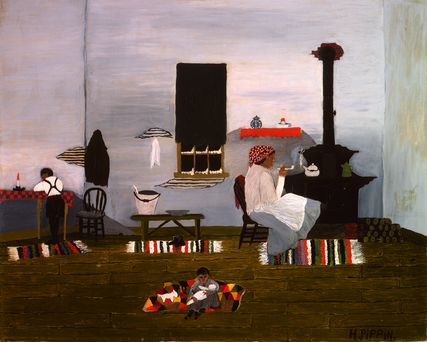
Horace Pippin, Interior, 1944

Okay, I know we have all gotten some great enjoyment from the contemporary art at the Basel, Berlin, Milan, and Torino fairs, but its time to get back to the history. So lets head back to France circa the fin-de-siecle, which means around the turn of the century, to discuss the Naïve art movement.
Naïve art lasted from circa 1895 to 1940 and is a type of representational painting classified by the use of "childlike" images and stylistic techniques. Much like the abstract contemporary art is often assumed to be simplistic in technical ability, the style was actually quite advanced for its time. Many of the images were inspired by the primitive and exotic images that had emerged since travel to the East had proliferated.
The representational images are also characterized by highly imaginative works, such as those seen in Henri Rousseau's (1884-1910) The Sleeping Gypsy (1897). Another well-known artists in the genre is the African American artist Horace Pippin (1888-1946) , who focused on folk-style art with figures representing content from life in the black community as seen in his image Interior (1944). Séraphine de Senlis (1864–1942), was a French painter who focused on representing religious and mystical imagery. She also painted still-life styles with a technique that rendered it more exotic than simply representational, such as in Les Fruits (1928). Among other artists that created works in this primitive style is the American Edward Hicks, and the Georgian Niko Pirosmani.
The representational images are also characterized by highly imaginative works, such as those seen in Henri Rousseau's (1884-1910) The Sleeping Gypsy (1897). Another well-known artists in the genre is the African American artist Horace Pippin (1888-1946) , who focused on folk-style art with figures representing content from life in the black community as seen in his image Interior (1944). Séraphine de Senlis (1864–1942), was a French painter who focused on representing religious and mystical imagery. She also painted still-life styles with a technique that rendered it more exotic than simply representational, such as in Les Fruits (1928). Among other artists that created works in this primitive style is the American Edward Hicks, and the Georgian Niko Pirosmani.
Notes:
(1) "naïve art." Encyclopædia Britannica. 2010. Encyclopædia Britannica Online. 04 Jun. 2010 <http://www.britannica.com/EBchecked/topic/401931/naive-art>.
(2) Helen Gardner, Fred S. Kleiner, Christin J Mamiya, Gardner's Art Through the Ages: The Western Perspective ed. 12 (Florence: Wadsworth Publishing), 2006, 721.
(3) Celester-Marie Bernier, African American visual arts (Edinburgh: Edinburgh University Press), 2008, 92.
(4) Bernier, 103.
(5)Karl Ruhrberg, Klaus Honnef, Manfred Schneckenburger, Ingo F. Walther, Christiane Fricke, Art of the 20th century, Part 1 (Köln: Taschen), 2000, 806.
For more information please refer to Wikipedia.
(1) "naïve art." Encyclopædia Britannica. 2010. Encyclopædia Britannica Online. 04 Jun. 2010 <http://www.britannica.com/EBchecked/topic/401931/naive-art>.
(2) Helen Gardner, Fred S. Kleiner, Christin J Mamiya, Gardner's Art Through the Ages: The Western Perspective ed. 12 (Florence: Wadsworth Publishing), 2006, 721.
(3) Celester-Marie Bernier, African American visual arts (Edinburgh: Edinburgh University Press), 2008, 92.
(4) Bernier, 103.
(5)Karl Ruhrberg, Klaus Honnef, Manfred Schneckenburger, Ingo F. Walther, Christiane Fricke, Art of the 20th century, Part 1 (Köln: Taschen), 2000, 806.
For more information please refer to Wikipedia.


