Showing posts with label art blog. Show all posts

Monday, November 29, 2010

Styles and Movements: Naïve Art


Henri Rousseau, The Sleeping Gypsy, 1897
Oil on Canvas, Museum of Modern Art, New York, 4'3" x 6'7" 


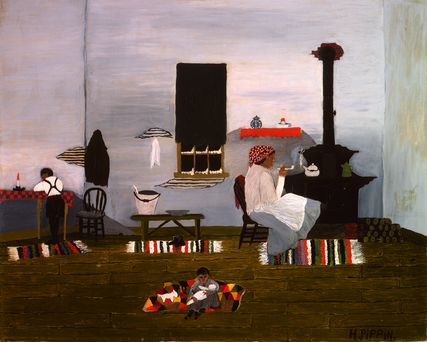
Horace Pippin, Interior, 1944

Séraphine de Senlis, Les Fruits, 1928
Okay, I know we have all gotten some great enjoyment from the contemporary art at the Basel, Berlin, Milan, and Torino fairs, but its time to get back to the history. So lets head back to France circa the fin-de-siecle, which means around the turn of the century, to discuss the Naïve art movement

Naïve art lasted from circa 1895 to 1940 and is a type of representational painting classified by the use of "childlike" images and stylistic techniques. Much like the abstract contemporary art is often assumed to be simplistic in technical ability, the style was actually quite advanced for its time. Many of the images were inspired by the primitive and exotic images that had emerged since travel to the East had proliferated. 


The representational images are also characterized by highly imaginative works, such as those seen in Henri Rousseau's (1884-1910) The Sleeping Gypsy (1897). Another well-known artists in the genre is the African American artist Horace Pippin (1888-1946) , who focused on folk-style art with figures representing content from life in the black community as seen in his image Interior (1944). Séraphine de Senlis (1864–1942), was a French painter who focused on representing religious and mystical imagery. She also painted still-life styles with a technique that rendered it more exotic than simply representational, such as in Les Fruits (1928). Among other artists that created works in this primitive style is the American Edward Hicks, and the Georgian Niko Pirosmani


Notes: 
(1) "naïve art." Encyclopædia Britannica. 2010. Encyclopædia Britannica Online. 04 Jun. 2010 <http://www.britannica.com/EBchecked/topic/401931/naive-art>.
(2) Helen Gardner, Fred S. Kleiner, Christin J Mamiya, Gardner's Art Through the Ages: The Western Perspective ed. 12 (Florence: Wadsworth Publishing), 2006, 721.
(3) Celester-Marie Bernier, African American visual arts (Edinburgh: Edinburgh University Press), 2008, 92. 
(4) Bernier, 103.
(5)Karl Ruhrberg, Klaus Honnef,  Manfred Schneckenburger, Ingo F. Walther, Christiane Fricke, Art of the 20th century, Part 1 (Köln: Taschen), 2000, 806. 
 For more information please refer to Wikipedia.

Monday, September 6, 2010

Blog Hiatus: Thesis Deadline!

Well, it's getting very close to my thesis deadline. I guess you can tell that this will mean I am going to be missing for a couple of weeks. 

However, I wanted to leave you guys with something to think about while I am gone. 

It has nothing to do with art, but it has to do with blogging and I just think it is very clever. Without further ado, please enjoy other peoples excuses for why they haven't posted

So for now I will just say, keep on the look out for more blogs coming up in some time in September. 

Monday, August 30, 2010

Reverse Artist Interview- Part 2

So here is the second half of the reverse interview. Thanks so much to all of you who sent questions! Enjoy!

I like how you're interested in current artists, when I'm sure so many of your peers probably prefer to talk about dead artists, right? 
It's true that a major portion of art historians prefer to research work from what I call pre-modernism (from antiquity, the Renaissance, and Neo-Classicism, etc), but it really great to see that the art history field is expanding to include Modern and Contemporary, Asian, African Diaspora, Islamic and Latin American art. 
However, yes, I think you are right in stating that most historians prefer to research 'dead artists', and I think that is linked to two major issues: 
(1) the general population prefers this work, they have a hard time understanding/relating to modern art. 
(2) There is a strange terminology problem when you begin researching contemporary artists- am I an art historian or an art critic? Because of that, I think art historians who are purely interested in the historical side of art history tend to lean towards researching artists that have long been dead. (Its interesting to test this theory when you look at different major university art history programs- I can tell if the department is based on studying the classics by seeing if they call their department Art History or History of Art---obviously this is never 100% true) 


How do you see yourself as compared with other art historians?
I don't really compare myself to other art historians. I didn't attend any academic programs where there are 20-30 other art historians (at my level) just sitting around chatting, so I never felt a competition to size myself up. And, when I do attend lectures and conferences I am either there as a student, in which case I am in awe of the other art historians and trying to learn, or as a lecturer, and I am too focused on my presentation to compare myself. I think the most important thing for me is that I succeed at making my path, and that is going to be completely different that another art historian as I don't really define myself in that way. 

With the lines that divide fine art, design, and craft now blurring, it's becoming evident that visual art is assuming a special and progressive role in the 21st century. But what role do you see contemporary artists (working in 2010) having? 
I think contemporary artists have a pretty daunting task, because interest in supporting the arts through government institutions is waning and that is not good, especially in the United States. As funds go out the window, artists are pressured (both internally and externally) to create work that is both economical but also reignites public interest in supporting the arts. It's also the task of people like me to make the general population realize that lack of support in the arts will draw us back into a cultural 'Dark Age' and thats just not an option in 2010 or at anytime. 


What impact artists they make this century and how will that differ from past centuries?
Well, based on following trends and personal research I have done, I think artists are reverting to older habits. For decades the major relationship has been between the isolated artist and the gallery. I think due to economic and social events artists are returning to a time when the artists collective and community worked as a united force. And the likelihood of success is pretty high because of the low or no-cost dissimilation of ideas via technology. 


As an art historian, you've come in contact with so many art movements, eras, phases, trends--- what have you. Some of these may be enormously vital, some not. Which "movement" do you think we could have done without?

Ugh, I really don't like this question. Its hard because I can't just ignore the efforts of a group of people from a different time, since I have no first-hand knowledge of how this work affected the community. And as a historian its my job to view all the facts as they are presented, working from that. 


Having said that, if I had to answer the question, I would probably say that I would wipe the term Degenerate Art or entartete Kunst out of the history books. The fact that Hitler and the Nazis were able to discount (and rename) the achievements of basically every Modern artist for their own gain, and that this term still exists is awful.

What is your favorite cartoon from 1980-1990?

Cartoon is a pretty comprehensive term. I will say that the cartoons I remember wanting to watch the most as a little Sicilian stuck in Dallas, Texas were some of the old Italian VHS tapes my parents brought over when we moved in the early 1990s. I especially liked watching a series called Esplorando Il Corpo Umano (Exploring the Human Body). I think these videos were my parents fun way of educating us on the functions of the human body, but also retaining some Italian language influences. Also, they succeeded in making us comfortable talking about and seeing images of human anatomy. I still remember the episode on cavities and their way of describing DNA, muscles, and the nervous system


What's your dream job....and where?
Right now, I want to be a cog in an art collective/art space that unites artists from the Americas...in Dallas. 

Monday, August 23, 2010

Reverse Artist Interview- Part 1

I've been holding one to this one for a while, but I figured that during the August lull, it would be good to post this. I recently turned the tables on myself and answered my own interview questions. After a few artist interviews, I only thought it fair to have to 'go through' the scrutiny I forced them to endure. 


Enjoy! Oh, and if you have any questions to add, please feel free to comment, there is still Part II to come!

Name: Ester Ippolito
Current City: Oggebbio, Piedmont, Italy
Hometown: Palermo, Sicily/ Dallas, Texas
Preferred Medium: speech, text, ink, photography, printmaking
Education: BA-University of Dallas; MPhil (expected) University of Kent
Website Link: duh. 
Gallery Link: not yet, but one day I will.

Tell me about you work in one sentence: 
I am interested in learning about art: what it is, the people, the history, the motivations…everything. I am aware that there is a wealth of information pertaining to art history and I want to share it with the ‘silent majority.’ In my own art, I am still searching.

Would you prefer to work at a gallery or a museum, why? 
Both. I haven’t decided if I want to go into the public sector or the private sector. I am sure like every other choice in my life, I will have to experience both and see which suits me best. I do know that whatever I do, it should be non-profit. Money complicates things and turns art into too much of a commodity. 


What is your favorite forum/method of sharing information about art? 
Word of mouth, I like talking (especially about art.) In this blog I talk about many different places- but I try to take a local approach. I think that if people step outside their door and find the hidden jems in their own neighborhood, then they are much more likely to do the same thing when they visit another city. Eventually, when I move somewhere a little more permanent I will try to focus on that place, but for now- the world is my playground. 


Your work is selected to show in a gallery or museum in the world, where would you choose? 
If I could curate a show anywhere in the world, I would probably choose something close to home, like the Rachofsky House, and make it a party with friends, music, food, and drinks. I like the idea of taking the art out of the museum and putting it in a home. I think the general public doesn’t relate well to the white walls and empty hallways of museums and galleries. Plus, food and music make art so much more enjoyable! Note: When I say close to home, I mean Dallas. I love Palermo, but I would want to be in an environment where I am surrounded by friends, family, and my history. Stories from my adolescence that creep out of the walls. Not to say that I don't have this in Palermo, I just have much more of it in Dallas. 


In what period of your career did you feel most aware of the needs of your audience, if ever? 
In several instances. In 2005 while touring the Sistine Chapel (Rome) with my sister and her friend, they asked me some questions and all of a sudden, I became their docent. It was fun and I was good at it. In the senior year of my BA I realized that I had to make a choice to between focusing on art history or studio art. Obviously, I chose art history, but it was due to the fact that I had become a sort of art guru for some of my friends and I loved talking about art, especially when it was due to a particular question they asked. After university, I had idealistic goals to work in a London gallery or move to New York and ‘make it.’ For my MA I moved to the UK to achieve these goals, but I realized when I returned to Dallas in the summer that if I couldn’t change the pre-conceived notions about art that my friends and family shared, then what was the point? Art should be shared! So I guess that’s was when I decided to take a grassroots approach. I never gave up on the dream of curating or working in a major art center, I just gave myself a bit more wiggle room. 


The art world right now is experiencing a newfound medium of exchanging information virtually. Do you think that this has affected the relevance of galleries, studios, and museums? 
I think if anything, these places have become more relevant. Blogs like mine have helped to make receiving information about obscure topics so much easier. You can literally find information about anything on the web. This sharing of information makes it easier for someone to know about art events in their own neighborhood as well as abroad. 


Would you rather have your work well known in the art community or well understood in the general population? 
I never got into art to become a household name. I don’t care if I am a faceless entity behind a great project. I would rather be a part of a program that is well received and attended by hoards of people from every aspect of life. 


Who are your artistic influences? 
This is a tough question. When I think of artists from the entire history of art, I am most intrigued by those who went against the grain and did their own thing, whether by snubbing the Academy, art critics, or the general population. Right now I am really into the American Graffiti and Punk artists from the 1980s. Actually anything from the 1980s is of huge interest to me during this phase of my research. But I think the beauty of graffiti art is that it is made knowing it is not permanent, its free to the public, it typically deals with a social issue, and most of the time the artist is only known by their ‘tag’. I guess name wise, (those that I actually ‘know’ are) Keith Haring, Jean-Michel Basquiat, Blek le Rat, Fab 5 Freddy, Lee Quinones, ABOVE, and Banksy. I am also exploring the nature of the art collective and how it fits into our contemporary culture. 


What is it about your work that makes it different from current art historians and relevant in today’s society? 
My take on art is based on two factors: technology and money.

1) We are a generation that experienced the technological revolution at its prime, after most of the major advances had been discovered, but before they had been ‘tested’ on a majority of the population. As such, we got to experiment with this medium and shape it into something that best suits our needs and desires. Art blogs, virtual art catalogs, gallery websites, art-themed social networking sites (ARThood & ArtReview), all appeared because ‘we’ had an interest in them.

2)  I am part of generation that is experiencing the harshness of the market more than our predecessors. There are no jobs without experience and no experience without jobs. Due to this catch-22, I, like many other 20-somethings, have had to become more creative about fulfilling my desires. Although somewhat disappointing in the face of social norms, this situation is great. When money is tight you have to be more inventive whether you are talking about art, making art, or experiencing art. 
Also, due to a need to travel and ‘be part’ of whatever location I go to, I have a very small town approach to the art world. I like to use colloquial terms, I like to explain things so everyone understands and no one feels excluded, and I like it when people who had previously shied away from art begin talking about art. And perhaps the romantic side of me loves to see peoples eyes light up when they experience a work of art.


Its 2012 and as the Mayans predicted, the world ends. Every cultural link is destroyed, but luckily there are few survivors. You are among them and are selected to document our cultural past. What artifact/artwork would you choose to record first? 

I know that I would choose Picasso’s Weeping Woman (1937). But how could you talk about a work knowing that no one would ever again get to experience it first hand?  

But, after studying Postmodernism, I would really love to say none- we should just start over and see how society chooses to shape art history. But the historian in me would be disappointed, so much wonderful work, with so many links to ‘our’ past. Also art history helps artists look at the past for inspiration, but also to see what has been done and avoid imitation/repetition, so I think it would a necessity to have some records of styles, major works, etc. It would be tricky though, how do you teach art history without influencing artists.  

Monday, July 19, 2010

Basel Recap: Satellite Fairs- Volta

Take the experience I had at Liste and consider its opposite: that’s what Volta turned out to be. Engaging, lively, and friendly. Perhaps because it is located in a difficult part of the city to reach, it was great to feel like my presence was welcome. And of course, the art also impressed.

The intersection between historical subject matter and contemporary issues seemed to prevail at the fair.  As seen in Nandipha Mntambo’s hanging relief sculpture as well as in Alexander Tinei’s painting which intersected well with the scientific in Herwig Weiser’s Death before Disko and Rafael Lozano-Hemmer’s The Company of Colours. Also the edition artist of the fair was Troels Carlsen. His work was set apart from the other galleries and artists and given its own wall, much like at Robert Montgomery’s installation piece at the entrance of the Scope fair.

Death before Disko was particularly spellbinding. As I stood in front of the noisy and bright glass container, I realized that within the central area the very cold hardware was moving. The liquid was pulsating and it became very alive in my mind. When intersected with the electric sounds from below the contraption and warmth emitting from the sides, it felt like I was in the midst of a Frankenstein experiment. This very technological work was coming to life before my eyes.

After a few minutes I broke free from my trance and asked the gallerist some questions. She explained that the black ‘goo,’ for lack of a better term, dimples and spins due to a dual magnet pull. The gallery describes that the piece is meant to “return to the foundations of hardware” to “show how our relationship towards technology is more often emotional than rational.” Considering my initial reaction, I think the piece is rather successful. 

Herwig WeiserDeath before Disko, 2006
speaker, plexiglas,motor, magnetic liquide, light-emitting diode, pc


Nandipha Mntambo, Title and Date Unknown, cowhide, resin
Brodie/Stevenson, Johannesburg

Troels Carlsen, View of Several Works at Volta 

Alexander Tinei, Haircut, 2010

120 x 100 cm, Oil on Canvas

Rafael Lozano-Hemmer, The Company of Colours, 2009,
Shadow Box 9, Edition 1 of 6, 1AP
High resolution interactive display with built-in computerized surveillance system

Friday, July 16, 2010

Basel Recap: Satellite Fairs- Liste


Of all the art events during the Art Basel week, I was least impressed by the Liste art fair. Whether this is due to listening to the opinions of others prior to experiencing it, a particularly bad run-in with a gallery there, or the fact that I had all of 25 minutes to walk through the four-story labyrinth, I am not sure. All I can say is that I did not enjoy my time there. Unlike the Volta and Scope fairs that are still rather young and in the process of establishing themselves, but not as recognized as Art Basel, Liste celebrated its 15th anniversary and boasts that it is the fair for the young galleries and hip artists.

However, it would not be fair to say that none of it roused my interest. I was impressed by the limits that some of the galleries pushed in their spaces. Some of the galleries such as Harris Lieberman (New York), Kaskadenkondensator (Basel), Wilfried Lentz (Rotterdam) embraced and worked with the industrial design of the abandoned factory. This was not something I saw with regularity at Art Basel, Scope, or Volta.

Unfortunately, I do not have as many options for photographs as with the other fairs. This is mostly due to my lack of time, as I have mentioned. But also, I did not get the sensation that the galleries present were interested in answering questions or ‘dealing’ with a non-collector, non-curator graduate student who dabbles in blogging about art (read: non-journalist). So enjoy the limited images I have, form your own opinions, and if you have more questions take a look at Liste.

The following are some images I took of art spaces that were intriguing:


Oscar Tuazon, Title and Date Unknown
Gallery Unknown*


*Sorry Guys, I usually better at giving credit where credit is due, but I was in a rush to get back to work!

Wednesday, July 7, 2010

Basel Recap: Art Basel


When I entered the Art Basel building, I knew immediately that I was out of my comfort zone and my league. It’s true that I love art, but my first impression was that this fair was what one would imagine if the Uffizi in Florence became a department store for art. Sure the art was impressive; there is no questioning that. But for someone new to this type of fair, it was overwhelming. 

So I did what any good assistant would do and followed my boss around like a lost puppy. Boy, am I glad I did. Not only did I learn the fine art of selective ‘gaze-walking,’ but also I was introduced to more art people than I have word count to list. 

In my jaw-dropped, frozen state my camera skills became non-existent. I apologize for the lack of images; most of the shots I took were to capture the essence of the fair and not so much the art. However, I don’t think I can be blamed for this methodology. Let me explain. I returned to the fair a couple more times during the week. As you can imagine, once was not enough. Each time I just was not able to focus on the art. There were too many people talking too much. Not just talking, schmoozing. The art lost value in this setting. It was just a commodity. As some of the artist and gallery owners reiterated to me, at the end of the day- Art Basel is a giant sale.

The last evening of the fair, while at the Art Basel Finale and then at the Art Basel dinner, I spoke to several artists of my sincere desire to walk through the fair with headphones on. They all agreed that it was a terrific idea. But it wasn’t just the sound of networking that was distracting; it was also the lack of interest and respect for the art.

Despite these drawbacks, I have no doubts I will return to the fair again. Why? Because, where else can you experience so much art created by artists from so many locations around the world. Also, the art is great and if you get a chance to be VIP, then you do get a few hours to search the fair grounds without the mobs.


(1) Gagosian Gallery; New York, Beverly Hills, London, Rome, Hong Kong
(2)White Cube; GB- London, Central Work: Damien Hirst, Anatomy of an Angel, 2008
(3)L&M Arts; US-New York, Central Work: Tom Friedman, Untitled (School Chair), 1992-2010
(4)Matthew Marks Gallery; US- New York, Central Work: Katharina Fritsch, Madonnafigur/ Madonna Figure, 1978/2009

Tuesday, June 29, 2010

Recap: Art Basel Unlimited

Art Basel has come and gone, but I wanted to take a couple of posts to recap my experiences in image and word. 

Of all the Art Basel sections, I was truly impressed by the works in the Art Unlimited area. This element of Art Basel began in 2000 and has since then focused on exhibiting works that “transcend the classical art-show stand- including video projections, large-scale installations, massive sculptures and live performances.”*


And boy did they transcend. I was blown away by the sheer mass of some of the works. It was also delightful to be able to interact with and touch works such as Michelangelo Pistoletto’s Labirinto e Grande Pozzo (1969/2010) and Agnes Varda's La cabane sur la plage (qui est aussi une cabine de projection), 2010. In Pistoletto's work I was not only trying to find my way through the massive cardboard maze to the central ‘well,’ but I was dealing with other viewers as they passed me or stood in my way. As we all focused on reaching the central point and then moving towards the opposite exit I became aware that this interaction with the other viewers was perhaps more important that the giant mirrored ‘well’ that reflected our images.

Yayoi Kusama’s Aftermath of the Obliteration of Eternity (2008) was an interesting work that the viewers got to enter (3 at a time). The most basic explanation for it was that the space was a lightshow set on a timer. This was due to the hundreds of floating candles. But it was much more than that. The space was moving, and the pattern of the flickering lights was an intense experience that called upon memories of searching for, stumbling to light, and holding candles after a major catastrophe.


There were so many installations that clearly intended to capture and hold the audiences attention. I highly recommend you taking some time to enjoy the images and video of  below. These were just a few of the works that interested me. But don't worry if you aren't drawn to anything here, this is just the tip of the Basel iceberg. Many more gallery, artist, fair reviews are coming soon!


Michelangelo Pistoletto, Labirinto e Grande Pozzo, 1969/2010 
Galleria Continua, It-San Gimignano/CN-Beijing/FR-Le Moulin

Glen Rubsamen, A Fever Dream, 2010
Mai 36 Gallery & Annemarie Verna Galerie, CH- Zurich; Alfonso Artiaco, IT- Naples 

Yayoi Kusama, Aftermath of the Obliteration of Eternity, 2008
Gagosian Gallery,US- NYC

Ugo Rondinone, Clockwork for Oracles II, 2008
 Gladstone Gallery, US-NYC

Zhang Huan, Hero No. 1, 2009
The Pace Gallery, US- NYC


Doug Aitken, Frontier, 2009
303 Gallery, US- NYC & Regen Projects, LA; Presenhuber, CH- Zurich; Miro, GB- London


* Description from the Art Basel website: see the link for Art Basel Unlimited. To find out more about these works and others, consult this webpage.