Showing posts with label art education. Show all posts

Monday, November 29, 2010

Styles and Movements: Naïve Art


Henri Rousseau, The Sleeping Gypsy, 1897
Oil on Canvas, Museum of Modern Art, New York, 4'3" x 6'7" 


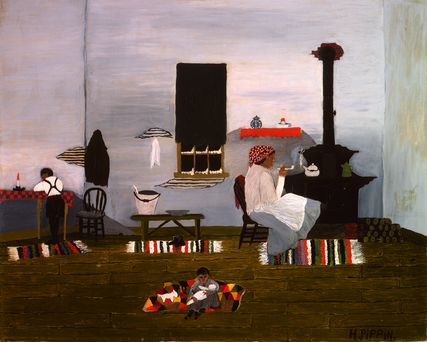
Horace Pippin, Interior, 1944

Séraphine de Senlis, Les Fruits, 1928
Okay, I know we have all gotten some great enjoyment from the contemporary art at the Basel, Berlin, Milan, and Torino fairs, but its time to get back to the history. So lets head back to France circa the fin-de-siecle, which means around the turn of the century, to discuss the Naïve art movement

Naïve art lasted from circa 1895 to 1940 and is a type of representational painting classified by the use of "childlike" images and stylistic techniques. Much like the abstract contemporary art is often assumed to be simplistic in technical ability, the style was actually quite advanced for its time. Many of the images were inspired by the primitive and exotic images that had emerged since travel to the East had proliferated. 


The representational images are also characterized by highly imaginative works, such as those seen in Henri Rousseau's (1884-1910) The Sleeping Gypsy (1897). Another well-known artists in the genre is the African American artist Horace Pippin (1888-1946) , who focused on folk-style art with figures representing content from life in the black community as seen in his image Interior (1944). Séraphine de Senlis (1864–1942), was a French painter who focused on representing religious and mystical imagery. She also painted still-life styles with a technique that rendered it more exotic than simply representational, such as in Les Fruits (1928). Among other artists that created works in this primitive style is the American Edward Hicks, and the Georgian Niko Pirosmani


Notes: 
(1) "naïve art." Encyclopædia Britannica. 2010. Encyclopædia Britannica Online. 04 Jun. 2010 <http://www.britannica.com/EBchecked/topic/401931/naive-art>.
(2) Helen Gardner, Fred S. Kleiner, Christin J Mamiya, Gardner's Art Through the Ages: The Western Perspective ed. 12 (Florence: Wadsworth Publishing), 2006, 721.
(3) Celester-Marie Bernier, African American visual arts (Edinburgh: Edinburgh University Press), 2008, 92. 
(4) Bernier, 103.
(5)Karl Ruhrberg, Klaus Honnef,  Manfred Schneckenburger, Ingo F. Walther, Christiane Fricke, Art of the 20th century, Part 1 (Köln: Taschen), 2000, 806. 
 For more information please refer to Wikipedia.

Monday, August 23, 2010

Reverse Artist Interview- Part 1

I've been holding one to this one for a while, but I figured that during the August lull, it would be good to post this. I recently turned the tables on myself and answered my own interview questions. After a few artist interviews, I only thought it fair to have to 'go through' the scrutiny I forced them to endure. 


Enjoy! Oh, and if you have any questions to add, please feel free to comment, there is still Part II to come!

Name: Ester Ippolito
Current City: Oggebbio, Piedmont, Italy
Hometown: Palermo, Sicily/ Dallas, Texas
Preferred Medium: speech, text, ink, photography, printmaking
Education: BA-University of Dallas; MPhil (expected) University of Kent
Website Link: duh. 
Gallery Link: not yet, but one day I will.

Tell me about you work in one sentence: 
I am interested in learning about art: what it is, the people, the history, the motivations…everything. I am aware that there is a wealth of information pertaining to art history and I want to share it with the ‘silent majority.’ In my own art, I am still searching.

Would you prefer to work at a gallery or a museum, why? 
Both. I haven’t decided if I want to go into the public sector or the private sector. I am sure like every other choice in my life, I will have to experience both and see which suits me best. I do know that whatever I do, it should be non-profit. Money complicates things and turns art into too much of a commodity. 


What is your favorite forum/method of sharing information about art? 
Word of mouth, I like talking (especially about art.) In this blog I talk about many different places- but I try to take a local approach. I think that if people step outside their door and find the hidden jems in their own neighborhood, then they are much more likely to do the same thing when they visit another city. Eventually, when I move somewhere a little more permanent I will try to focus on that place, but for now- the world is my playground. 


Your work is selected to show in a gallery or museum in the world, where would you choose? 
If I could curate a show anywhere in the world, I would probably choose something close to home, like the Rachofsky House, and make it a party with friends, music, food, and drinks. I like the idea of taking the art out of the museum and putting it in a home. I think the general public doesn’t relate well to the white walls and empty hallways of museums and galleries. Plus, food and music make art so much more enjoyable! Note: When I say close to home, I mean Dallas. I love Palermo, but I would want to be in an environment where I am surrounded by friends, family, and my history. Stories from my adolescence that creep out of the walls. Not to say that I don't have this in Palermo, I just have much more of it in Dallas. 


In what period of your career did you feel most aware of the needs of your audience, if ever? 
In several instances. In 2005 while touring the Sistine Chapel (Rome) with my sister and her friend, they asked me some questions and all of a sudden, I became their docent. It was fun and I was good at it. In the senior year of my BA I realized that I had to make a choice to between focusing on art history or studio art. Obviously, I chose art history, but it was due to the fact that I had become a sort of art guru for some of my friends and I loved talking about art, especially when it was due to a particular question they asked. After university, I had idealistic goals to work in a London gallery or move to New York and ‘make it.’ For my MA I moved to the UK to achieve these goals, but I realized when I returned to Dallas in the summer that if I couldn’t change the pre-conceived notions about art that my friends and family shared, then what was the point? Art should be shared! So I guess that’s was when I decided to take a grassroots approach. I never gave up on the dream of curating or working in a major art center, I just gave myself a bit more wiggle room. 


The art world right now is experiencing a newfound medium of exchanging information virtually. Do you think that this has affected the relevance of galleries, studios, and museums? 
I think if anything, these places have become more relevant. Blogs like mine have helped to make receiving information about obscure topics so much easier. You can literally find information about anything on the web. This sharing of information makes it easier for someone to know about art events in their own neighborhood as well as abroad. 


Would you rather have your work well known in the art community or well understood in the general population? 
I never got into art to become a household name. I don’t care if I am a faceless entity behind a great project. I would rather be a part of a program that is well received and attended by hoards of people from every aspect of life. 


Who are your artistic influences? 
This is a tough question. When I think of artists from the entire history of art, I am most intrigued by those who went against the grain and did their own thing, whether by snubbing the Academy, art critics, or the general population. Right now I am really into the American Graffiti and Punk artists from the 1980s. Actually anything from the 1980s is of huge interest to me during this phase of my research. But I think the beauty of graffiti art is that it is made knowing it is not permanent, its free to the public, it typically deals with a social issue, and most of the time the artist is only known by their ‘tag’. I guess name wise, (those that I actually ‘know’ are) Keith Haring, Jean-Michel Basquiat, Blek le Rat, Fab 5 Freddy, Lee Quinones, ABOVE, and Banksy. I am also exploring the nature of the art collective and how it fits into our contemporary culture. 


What is it about your work that makes it different from current art historians and relevant in today’s society? 
My take on art is based on two factors: technology and money.

1) We are a generation that experienced the technological revolution at its prime, after most of the major advances had been discovered, but before they had been ‘tested’ on a majority of the population. As such, we got to experiment with this medium and shape it into something that best suits our needs and desires. Art blogs, virtual art catalogs, gallery websites, art-themed social networking sites (ARThood & ArtReview), all appeared because ‘we’ had an interest in them.

2)  I am part of generation that is experiencing the harshness of the market more than our predecessors. There are no jobs without experience and no experience without jobs. Due to this catch-22, I, like many other 20-somethings, have had to become more creative about fulfilling my desires. Although somewhat disappointing in the face of social norms, this situation is great. When money is tight you have to be more inventive whether you are talking about art, making art, or experiencing art. 
Also, due to a need to travel and ‘be part’ of whatever location I go to, I have a very small town approach to the art world. I like to use colloquial terms, I like to explain things so everyone understands and no one feels excluded, and I like it when people who had previously shied away from art begin talking about art. And perhaps the romantic side of me loves to see peoples eyes light up when they experience a work of art.


Its 2012 and as the Mayans predicted, the world ends. Every cultural link is destroyed, but luckily there are few survivors. You are among them and are selected to document our cultural past. What artifact/artwork would you choose to record first? 

I know that I would choose Picasso’s Weeping Woman (1937). But how could you talk about a work knowing that no one would ever again get to experience it first hand?  

But, after studying Postmodernism, I would really love to say none- we should just start over and see how society chooses to shape art history. But the historian in me would be disappointed, so much wonderful work, with so many links to ‘our’ past. Also art history helps artists look at the past for inspiration, but also to see what has been done and avoid imitation/repetition, so I think it would a necessity to have some records of styles, major works, etc. It would be tricky though, how do you teach art history without influencing artists.  

Thursday, May 27, 2010

Special Edition: Favorite Art Websites

For a few months now I have been writing about art events, festivals, artists, and galleries. But I've realized that you might be wondering, where does she get all this great information?The answer is, the internet. The real skill lies in knowing where to look. So, I decided this week I would post about the websites I visit most often.


The websites are listed in no particular order. Search through them and find out which one works best for you. If you have any questions, as always feel free to email or comment.


Buying Art Online
- Etsy
- 20x200
- artnet


News
- ARTINFO
- artnews.org
- Mutual Art
- FAD art fast news
artandseek


Social Networks
- ArtReview
- ARThood
- Art Education 2.0


Blogs
- Art Re-Source
- Art Fag City
- Art Rabbit
- Art: 21 Blog
- Art Observed
- Contemporary Art Daily


Academic
- Cornucopia
- The Social History of Art
- History of Art Timeline
- ArtLex: Art Dictionary
- Berger Foundation World Art Treasures


To find more websites try:
- Exploratorium
- Incredible Art


Note: I am taking a little vacation time to travel through Europe, but I will be back on mid-June.  Enjoy perusing through these websites in the meantime! 


* The Dallas Fine Arts Examiner and artandseek are specifically catered to North Texas events. If you are not interested in knowing about art events in Dallas, do a quick search of your local newspapers to find an art news section you like in your area.  

Monday, March 1, 2010

Styles and Movements: Macchiaioli

I'm back to the art blogging world. This week I am going to begin with another a Modern art movement, the Macchiaioli. Enjoy!
File:Giovanni Fattori.jpg
Giovanni Fattori, Cowboys of the Maremma Driving the Herds, 1893
Oil on canvas, 200 x 300 cm, Livorno, Museo Civico Fattori
Sulle colline a Settignano, 1885

Macchiaioli was a style related to the Impressionism and similarly criticized by the academy. Formed by a group of Florentine and Neapolitan painters in Florence, their painting style featured the paint rather than narratives. They painted in a sketch manner that highlighted their “initial impressions of nature,” in color, light, and shadows, primarily painting outdoors.[1] The group’s name, Macchiaioli, refers to the painter’s effort to emphasize the areas of light and shade by marking the painting with spots. These marks or stains of color were referred to as “macchie.” Preceding the French Impressionists, the Macchiaioli began with a group of artists in the 1850s that were tired of the stifling academies and sought to reinvigorate Italian painting. Influenced by the old masters (Caravaggio) as well as the French Barbizon School, the Macchiaioli (including artist Telemaco Signorini) changed Italian painting. Undervalued during its time, the movement lasted from 1860 to 1890.


For more information refer to:
Broude, Norma. The Macchiaioli: Italian Painters of the Nineteenth Century. London: Yale University Press, 1987.
Steingräber, E., & Matteucci, G. The Macchiaioli: Tuscan Painters of the Sunlight : March 14-April 20, 1984. New York: Stair Sainty Matthiesen in association with Matthiesen, London, 1984.

Turner, J. Grove Dictionary of Art. USA: Oxford University Press, 1996.

Monday, February 1, 2010

Artist Interview: Carol Mackiewicz

This artist interview is a bit different, because Carol Mackiewicz is an artist who uses her talents as a form of counseling through art therapy. I think it is critical to understand that artists are linked to many different fields through diverse specializations, not only the art market. Enjoy!

Coffee and the Beatles, 2007
Oil on Canvas

Tinneburg Abbey, 2008
Oil Pastel

Name: Carol L. Mackiewicz                       
Current City: Santa Fe, NM           
Hometown: Wales, MA
Preferred Medium: Oil painting and oil pastels
Education: University of Dallas, Art/Painting, Expected MA in Art Therapy/Counseling at Southwestern College 
Tell me about you paintings in one sentence:  My work conveys themes of personal emotions explored through color and texture of paint, oil pastels, and/or symbols.

What is your favorite forum/method of sharing information about art?  I love to educate other people about art; I currently work with girls ages 5-12 in an afterschool program and love teaching them art methods and the history behind why artists did what they did and how it affects their current world.

In what period of your career did you feel most aware of the needs of your audience, if ever?  I felt the need for art to convey healing qualities not just for the artist but also for the viewers when I was a junior in college.  We were studying German Expressionism and my icon of painters, Wassily Kandinsky wrote in his Concerning the Spiritual in Art, that it was the time for artists to carry the energy of change and progressive ideas for their own cultures.  I saw myself, at the time, as one of those artists who could bring something to the table to share with others, through my paintings and willingness to help facilitate change.

What is art therapy? Great question! Art therapy is the use of art as a modality in which to facilitate therapeutic methods to individuals, couples/families, and groups.  Basically, it is an expansion of traditional “talk therapy” into the realms of artistic expression as a means of uncovering layers of unconscious thoughts, symbols, behaviors, and emotions.

What made you realize that your talents could be used in this way?   I realized that art could be used as a healing modality when I realized my joy in painting happened through the use of colors and abstract images.  Such pictorial depictions spoke to the deeper, darker, unseen self within me.  I knew if such art could affect me, it could also affect and help others.

Did choosing to become an art therapist overshadow your own career as an artist? If so, does it matter?  My career as an artist is to be an art therapist.  There are times when I think, gosh, I do not have time or energy to do my own paintings, but I satiate my art desires through the art making process with clients and class directives.  I did not feel comfortable being a gallery artist, because I felt that the direction in which my art would go, would not be fulfilling sitting in a gallery, but rather in relationship with people.

The art world right now is experiencing a newfound medium of exchanging information virtually. Do you think that this has affected the relevance of galleries, studios, and museums? I think people will always find ways to provide convenience for viewing art.  However, there is something very important and intimate about viewing art in galleries, studios, and museums.  There is a life force surrounding each art piece, no matter its medium or presentation, and to engage in this relationship with the art firsthand, is in my opinion, the Truth of sharing art.

Would you rather have your work well known in the art community or well understood in the general population?  I would rather have my art well understood in the general population because those are the people I work with on a daily basis, providing an avenue to deeper understanding and appreciation of their daily lives that seem at times, so daunting and hopeless, but can change through art and the process of art.

Its 2012 and as the Mayans predicted, the world ends. Every cultural link is destroyed, but luckily there are few survivors. You are among them and are selected to document our cultural past. What artifact/artwork would you choose to record first?  There are so many! I would have to say, based on personal preferences, The Birth of Venus, by Botticelli.  It is a stunning example of an archetype portrayed in a balanced, technically clean painting that carries value over centuries both before its time and after.