Showing posts with label art history. Show all posts

Monday, November 29, 2010

Styles and Movements: Naïve Art


Henri Rousseau, The Sleeping Gypsy, 1897
Oil on Canvas, Museum of Modern Art, New York, 4'3" x 6'7" 


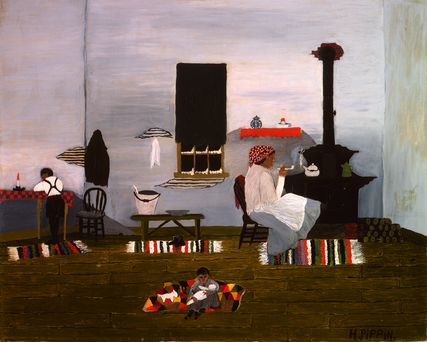
Horace Pippin, Interior, 1944

Séraphine de Senlis, Les Fruits, 1928
Okay, I know we have all gotten some great enjoyment from the contemporary art at the Basel, Berlin, Milan, and Torino fairs, but its time to get back to the history. So lets head back to France circa the fin-de-siecle, which means around the turn of the century, to discuss the Naïve art movement

Naïve art lasted from circa 1895 to 1940 and is a type of representational painting classified by the use of "childlike" images and stylistic techniques. Much like the abstract contemporary art is often assumed to be simplistic in technical ability, the style was actually quite advanced for its time. Many of the images were inspired by the primitive and exotic images that had emerged since travel to the East had proliferated. 


The representational images are also characterized by highly imaginative works, such as those seen in Henri Rousseau's (1884-1910) The Sleeping Gypsy (1897). Another well-known artists in the genre is the African American artist Horace Pippin (1888-1946) , who focused on folk-style art with figures representing content from life in the black community as seen in his image Interior (1944). Séraphine de Senlis (1864–1942), was a French painter who focused on representing religious and mystical imagery. She also painted still-life styles with a technique that rendered it more exotic than simply representational, such as in Les Fruits (1928). Among other artists that created works in this primitive style is the American Edward Hicks, and the Georgian Niko Pirosmani


Notes: 
(1) "naïve art." Encyclopædia Britannica. 2010. Encyclopædia Britannica Online. 04 Jun. 2010 <http://www.britannica.com/EBchecked/topic/401931/naive-art>.
(2) Helen Gardner, Fred S. Kleiner, Christin J Mamiya, Gardner's Art Through the Ages: The Western Perspective ed. 12 (Florence: Wadsworth Publishing), 2006, 721.
(3) Celester-Marie Bernier, African American visual arts (Edinburgh: Edinburgh University Press), 2008, 92. 
(4) Bernier, 103.
(5)Karl Ruhrberg, Klaus Honnef,  Manfred Schneckenburger, Ingo F. Walther, Christiane Fricke, Art of the 20th century, Part 1 (Köln: Taschen), 2000, 806. 
 For more information please refer to Wikipedia.

Monday, August 23, 2010

Reverse Artist Interview- Part 1

I've been holding one to this one for a while, but I figured that during the August lull, it would be good to post this. I recently turned the tables on myself and answered my own interview questions. After a few artist interviews, I only thought it fair to have to 'go through' the scrutiny I forced them to endure. 


Enjoy! Oh, and if you have any questions to add, please feel free to comment, there is still Part II to come!

Name: Ester Ippolito
Current City: Oggebbio, Piedmont, Italy
Hometown: Palermo, Sicily/ Dallas, Texas
Preferred Medium: speech, text, ink, photography, printmaking
Education: BA-University of Dallas; MPhil (expected) University of Kent
Website Link: duh. 
Gallery Link: not yet, but one day I will.

Tell me about you work in one sentence: 
I am interested in learning about art: what it is, the people, the history, the motivations…everything. I am aware that there is a wealth of information pertaining to art history and I want to share it with the ‘silent majority.’ In my own art, I am still searching.

Would you prefer to work at a gallery or a museum, why? 
Both. I haven’t decided if I want to go into the public sector or the private sector. I am sure like every other choice in my life, I will have to experience both and see which suits me best. I do know that whatever I do, it should be non-profit. Money complicates things and turns art into too much of a commodity. 


What is your favorite forum/method of sharing information about art? 
Word of mouth, I like talking (especially about art.) In this blog I talk about many different places- but I try to take a local approach. I think that if people step outside their door and find the hidden jems in their own neighborhood, then they are much more likely to do the same thing when they visit another city. Eventually, when I move somewhere a little more permanent I will try to focus on that place, but for now- the world is my playground. 


Your work is selected to show in a gallery or museum in the world, where would you choose? 
If I could curate a show anywhere in the world, I would probably choose something close to home, like the Rachofsky House, and make it a party with friends, music, food, and drinks. I like the idea of taking the art out of the museum and putting it in a home. I think the general public doesn’t relate well to the white walls and empty hallways of museums and galleries. Plus, food and music make art so much more enjoyable! Note: When I say close to home, I mean Dallas. I love Palermo, but I would want to be in an environment where I am surrounded by friends, family, and my history. Stories from my adolescence that creep out of the walls. Not to say that I don't have this in Palermo, I just have much more of it in Dallas. 


In what period of your career did you feel most aware of the needs of your audience, if ever? 
In several instances. In 2005 while touring the Sistine Chapel (Rome) with my sister and her friend, they asked me some questions and all of a sudden, I became their docent. It was fun and I was good at it. In the senior year of my BA I realized that I had to make a choice to between focusing on art history or studio art. Obviously, I chose art history, but it was due to the fact that I had become a sort of art guru for some of my friends and I loved talking about art, especially when it was due to a particular question they asked. After university, I had idealistic goals to work in a London gallery or move to New York and ‘make it.’ For my MA I moved to the UK to achieve these goals, but I realized when I returned to Dallas in the summer that if I couldn’t change the pre-conceived notions about art that my friends and family shared, then what was the point? Art should be shared! So I guess that’s was when I decided to take a grassroots approach. I never gave up on the dream of curating or working in a major art center, I just gave myself a bit more wiggle room. 


The art world right now is experiencing a newfound medium of exchanging information virtually. Do you think that this has affected the relevance of galleries, studios, and museums? 
I think if anything, these places have become more relevant. Blogs like mine have helped to make receiving information about obscure topics so much easier. You can literally find information about anything on the web. This sharing of information makes it easier for someone to know about art events in their own neighborhood as well as abroad. 


Would you rather have your work well known in the art community or well understood in the general population? 
I never got into art to become a household name. I don’t care if I am a faceless entity behind a great project. I would rather be a part of a program that is well received and attended by hoards of people from every aspect of life. 


Who are your artistic influences? 
This is a tough question. When I think of artists from the entire history of art, I am most intrigued by those who went against the grain and did their own thing, whether by snubbing the Academy, art critics, or the general population. Right now I am really into the American Graffiti and Punk artists from the 1980s. Actually anything from the 1980s is of huge interest to me during this phase of my research. But I think the beauty of graffiti art is that it is made knowing it is not permanent, its free to the public, it typically deals with a social issue, and most of the time the artist is only known by their ‘tag’. I guess name wise, (those that I actually ‘know’ are) Keith Haring, Jean-Michel Basquiat, Blek le Rat, Fab 5 Freddy, Lee Quinones, ABOVE, and Banksy. I am also exploring the nature of the art collective and how it fits into our contemporary culture. 


What is it about your work that makes it different from current art historians and relevant in today’s society? 
My take on art is based on two factors: technology and money.

1) We are a generation that experienced the technological revolution at its prime, after most of the major advances had been discovered, but before they had been ‘tested’ on a majority of the population. As such, we got to experiment with this medium and shape it into something that best suits our needs and desires. Art blogs, virtual art catalogs, gallery websites, art-themed social networking sites (ARThood & ArtReview), all appeared because ‘we’ had an interest in them.

2)  I am part of generation that is experiencing the harshness of the market more than our predecessors. There are no jobs without experience and no experience without jobs. Due to this catch-22, I, like many other 20-somethings, have had to become more creative about fulfilling my desires. Although somewhat disappointing in the face of social norms, this situation is great. When money is tight you have to be more inventive whether you are talking about art, making art, or experiencing art. 
Also, due to a need to travel and ‘be part’ of whatever location I go to, I have a very small town approach to the art world. I like to use colloquial terms, I like to explain things so everyone understands and no one feels excluded, and I like it when people who had previously shied away from art begin talking about art. And perhaps the romantic side of me loves to see peoples eyes light up when they experience a work of art.


Its 2012 and as the Mayans predicted, the world ends. Every cultural link is destroyed, but luckily there are few survivors. You are among them and are selected to document our cultural past. What artifact/artwork would you choose to record first? 

I know that I would choose Picasso’s Weeping Woman (1937). But how could you talk about a work knowing that no one would ever again get to experience it first hand?  

But, after studying Postmodernism, I would really love to say none- we should just start over and see how society chooses to shape art history. But the historian in me would be disappointed, so much wonderful work, with so many links to ‘our’ past. Also art history helps artists look at the past for inspiration, but also to see what has been done and avoid imitation/repetition, so I think it would a necessity to have some records of styles, major works, etc. It would be tricky though, how do you teach art history without influencing artists.  

Thursday, May 27, 2010

Special Edition: Favorite Art Websites

For a few months now I have been writing about art events, festivals, artists, and galleries. But I've realized that you might be wondering, where does she get all this great information?The answer is, the internet. The real skill lies in knowing where to look. So, I decided this week I would post about the websites I visit most often.


The websites are listed in no particular order. Search through them and find out which one works best for you. If you have any questions, as always feel free to email or comment.


Buying Art Online
- Etsy
- 20x200
- artnet


News
- ARTINFO
- artnews.org
- Mutual Art
- FAD art fast news
artandseek


Social Networks
- ArtReview
- ARThood
- Art Education 2.0


Blogs
- Art Re-Source
- Art Fag City
- Art Rabbit
- Art: 21 Blog
- Art Observed
- Contemporary Art Daily


Academic
- Cornucopia
- The Social History of Art
- History of Art Timeline
- ArtLex: Art Dictionary
- Berger Foundation World Art Treasures


To find more websites try:
- Exploratorium
- Incredible Art


Note: I am taking a little vacation time to travel through Europe, but I will be back on mid-June.  Enjoy perusing through these websites in the meantime! 


* The Dallas Fine Arts Examiner and artandseek are specifically catered to North Texas events. If you are not interested in knowing about art events in Dallas, do a quick search of your local newspapers to find an art news section you like in your area.  

Tuesday, April 27, 2010

Styles and Movements: French Naturalism

         
      Vincent Van Gogh, The Potato Eaters,  1885*

        Henri de Toulouse-Lautrec, At Grenelle, Absinthe Drinker, 1887**

        
         Eduoard Manet, A Bar at the Folies-Bergère, ca. 1882***


French Naturalism (1880-1890) was inspired by certain aspects of Realism. Realists, such as Gustave Courbet, depicted the every-day without embellishing it.  The French Naturalists depicted the reality of their world, but unlike Realism, they took more stylistic freedom. This is depicted in Manet’s A Bar at the Folies-Bergère.

French Naturalism also shared similarities with a style of literature used by Èmile Zola, Naturalism. This literary style focused on depicting that human character was shaped by society and by natural conditions.  Zola's texts, such as Thérèse RaquinL'Assommoir Nana, and Germinal show the most depraved but resilient side of humankind. Paintings such as Van Gogh’s The Potato Eaters and Toulouse-Lautrec’s At Grenelle, Absinthe Drinker depict this side of contemporary life. French Naturalism eventually changed because of the artist’s desire to romanticize aspects of daily life. Artists also extended beyond Realism and French Naturalism. By depicting contemporary life as it was, they produced a style that had a sketch-like quality. This style would evolve to become Impressionism.  


Notes: 
Please Refer to Wikipedia, Encyclopedia Brittanica for more information on the web or Gardner's Art Through the Ages textbook. 
Reprinted, Robert Wallace, The World of Van Gogh 1853-1890, Alexandria, VA: Time-Life Books, 1969.
** Reprinted, Thomson, Richard, Phillip Dennis Cate, and Mary Chapin Weaver, Toulouse-Lautrec and Montmartre. Princeton, NJ: Princeton University Press, 2005.
*** Reprinted, Eisenmann, Stephan F., ed, Nineteenth Century Art: A Critical History. London, UK: Thames & Hudson, Ltd, 2002.

Tuesday, April 13, 2010

Gallery and Exhibition Reviews: Raffaello Centro D'arte


 Pan

Da "La Figlia di Lot" Omaggio a Guttuso
(From "The Lot's Daughter" Homage to Guttuso)


Renato Guttuso, Title and Date Unknown 
(Guttuso is not a contemporary artist, but I have included this piece in reference to Meschis' work)


Oil on Canvas, 2009


On an uneventful weeknight in Palermo, I went to visit the Raffaello Centro d'arte (Center for the arts). I love visiting galleries versus museums because you get to see art that is made by local artists for FREE! 


Like most things in Italy, the gallery world and exhibition procedure is different from what I am used to in America. The space was pretty small, nothing larger than a standard American living room. When I walked in there were some paintings hung on the walls, but most of the work was stacked in a corner. The gallery assistant apologized for the confusion and explained that they had just finished exhibiting in another location. As I explained in the Antonello Blandi exhibition review, due to a lack of space in the galleries themselves most exhibitions are held in cultural hotspots around the city.


Finding a gallery between shows is a special treat, because you get to experience the no frills side of the art world. After a quick introduction by the assistant I was left to my own devices to wander through the space.


The work that was hung on the wall was not labeled, there was no special precedence given to any one piece.* It felt like I had just entered an artists studio. The gallery assistant gave me free rein to touch and move the works stacked against the wall and answered every question I had without hesitation and without giving me a sales pitch. She also allowed me to take photographs for the blog. (My apologies, I know they are pretty low quality!) 


Ignoring the couple of prerequisite lithographs by Salvador Dalí and Fernando Botero that seem to exist in every gallery, I was able to focus on the work of Sicilian artists Bruno Caruso, Renato Guttuso, and Meschis, and as well as other Italians, such as Roman artist Navarra.**


Here are a few of their works, if you have any questions about a particular piece you can contact the gallery directly or just email me!


Notes:
* Due to the lack of labels near the work, and the fact that I was not entirely sure the gallery assistant actually worked for the gallery, the paintings featured lack some information. If you really want some information, just email me and I will try to get it for you! 
**Although I do love the work done by Dali and Botero, this blog is focused on featuring  contemporary local artists. Also, I say prerequisite, because in my experience most galleries that focus purely on sales rather than exhibiting their artists seem to have one or two lithographs by a well-known artist hanging around. 

Tuesday, April 6, 2010

Artist Interview: Tex Jernigan

Messed up Flower, 2006
Hand wrought steel, 18"x6"x6"


Scottsdale Diamond, 2007
Scottsdale, Arizona


Flag of Louisiana, 2009
Kansas City, Missouri

Flag of Iran, 2009
Smithville Lake, Missouri


Name: Tex Jernigan 
Current City: Kansas City 
Hometown: Dallas 
Preferred Medium: Sculpture/Photography 
Education: Kansas City Art Institute 
Website Link: texjernigan.com


Tell me about you work in one sentence:
I design and construct illusions using simple materials as well as the physical world itself, and I then hold events where I invite people within the work and offer to take their picture for free, posting it.


I remember that your early sculptural illusions were made from a lot of steel poles. The image would morph depending on the perspective. How did this interest in optical illusion sculptures grow from this type of object to an interest in flags, an icon that represents not only a people but its government?
I think I started making flags as a way of distancing myself from the illusions I was making with perspective.  I realized that a magic trick isn't really about illusions and magic, it's about the people being tricked.  Without people, without an audience, a magician's trick doesn't exist, it's a vacuum where the magician is the only one involved and he knows how it works, so the trick is nullified.  I guess what I'm saying is that for me, the people became a central focus in my work.  And yes, I want to get Barack Obama inside of the Illinois flag, or better yet, the Chicago flag, it's a doozy.
I don't have a business plan yet. 


What is your favorite forum/method of sharing information about art?
The internet, of course, what other kind of forum is there? 


Your work is selected to show in a gallery or museum in the world, where would you choose?
Pernambuco, Brazil.  It has the most beautiful flag, and it's state capital, Recife, is the Venice of Brazil.


I wondered if you always choose the places you make sculptures for using this selection process, or if cultural/social/political issues ever play a role?
I have a friend who married a girl from Iran, and I created the Iranian flag for their wedding.  The traditional flag was chosen instead of the current flag, which most Iranians don't like, since the traditional flag was their flag for thousands of years, and the new one is less than a decade old.  But when the family showed up, some of them felt that to pose in front of the traditional flag could be an act of treason.  They ended up getting their picture taken, but they asked me not to post it online, so the only picture I posted was Brent (attached).

As a kid, I drew a lot, so it wasn't long before people began to praise my drawings.  I gradually stopped doing it for myself and started doing it for other people, and my artwork became a way for me to connect with people socially, and has continued to, so I'm most aware, now.


The art world right now is experiencing a newfound medium of exchanging information virtually. Do you think that this has affected the relevance of galleries, studios, and museums?
Yes. Let's add the word, "how" in front of "do."
The internet allows anybody to have a voice, so perhaps Galleries and Museums are more relevant, serving as a marker for an artist's success. There's a pretty good documentary by Ben Lewis which counters this argument,  http://www.youtube.com/watch?v=gth8_3msnIk  -- you would like it, it inadvertently explains why Van Gogh was the most famous artist when we were kids. 


Would you rather have your work well known in the art community or well understood in the general population?
I think that the general population is in the process of joining the art community, and I take pleasure in assisting that merge by putting individuals in the spotlight. 


Who are your artistic influences?
James Turrell, Andy Goldsworthy, and Christo


What is it about your work that makes it different from these people and relevant in today’s society?
I added "People" to the mix.


Its 2012 and as the Mayans predicted, the world ends. Every cultural link is destroyed, but luckily there are few survivors. You are among them and are selected to document our cultural past. What artifact/artwork would you choose to record first?
I would continue making my art - it requires nothing but my hands, my eyes, and the world around us. 


In that same train of thought, are you persuaded by people you encounter at all? For instance, if I said that Sicily has a particularly interesting flag, would that spur your interest?
Are you Sicilian?  I would make that flag for you, especially if we did it in Italy.  I'm often inspired by the people I encounter - I have a working visual knowledge of most flags in the world now, so it's a pretty good conversation starter.  Every person in the world has a flag or two that is part of their identity, and it's fun to celebrate it.


In what period of your career did you feel most aware of the needs of your audience, if ever?


Would you prefer to deal through gallery representation or directly with clients, why?